
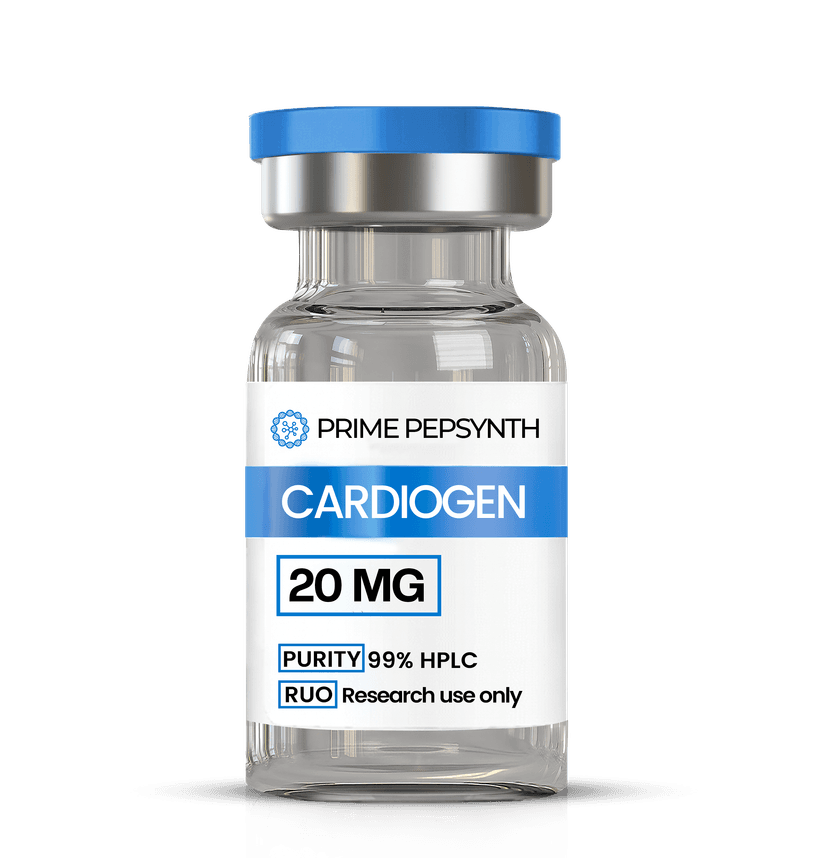
Cardiogen
is a peptide bioregulator derived from cardiac tissue extracts consisting of short amino acid chains that regulate myocardial gene expression and contractile protein synthesis. Experimental studies demonstrate its influence on calcium homeostasis, mitochondrial bioenergetics, and peptide-mediated cardiomyocyte repair. Cardiogen is used in cardiovascular research exploring cardiac peptide regulation, metabolic adaptation, and stress response mechanisms.
For research use only. Not for human consumption.
References:
Khavinson VK et al., Bull Exp Biol Med, 2002 134(4):356–359
Anisimov VN et al., Biochemistry (Moscow), 2000 65(8):901–908
Linkova NS et al., Adv Gerontol, 2011 24(4):628–634
Cardiogen
Cardiogen is a short peptide with known properties as a bioregulator.
Research shows that its primary effects are on fibroblasts, the cells
responsible for tissue repair and scar formation throughout the body.
Though the focus on cardiogen nas been on its role in a variety of
cardiovascular diseases (hence the name), research snows that its ability
to alter fibroblast activity has potential benefits in a variety of tissues. In
addition, cardiogen appears to by a synergistic peptide, enhancing the
benefit of certain standard therapies and thereby improving long-term
outcomes while reducing side effects. Finally, preliminary research in rat
models suggests that cardiogen may increase rates ot apoptosis in tumor
cells.
Cardiogen Structure
Molecular Formula: C18H31N70g
Molecular Weight: 489.5 g/mol
PubChem CID: 11583989
Alternative Names: SCHEMBL3194515
Cardiogen and the Heart
In the heart, cardiogen appears to stimulate cardiomyocyte proliferation
while reducing fibroblast growth and development. This leads to decreased
scar formation and improved long-term outcomes in regards to cardiac
remodeling leading to heart failure. Additionally, it appears that cardiogen
20mg can decrease p53 protein expression and thereby diminish rates of
apoptosis[l].
Cardiogen and Cancer
Even though cardiogen reduces apoptosis in heart cells by down-
regulating p53 expression, it may have the opposite effect in tumor cells.
Research in rat models of M-I sarcoma shows that apoptosis levels are
higher in the tumor cells following cardiogen administration. What is more,
the effect is does-dependent, indicating that the biological effect iS real[2].
The peptide appears to enhance apoptosis in tumor cells and may be
somewhat selective for tumor cells due to their enhanced and unusual
vascular supply. This may make cardiogen a targeted treatment for at least
some types of cancer. In addition, if the peptide enhances the action of
standard cancer treatments (as it does in heart disease treatment), then it
may prove a very potent addition to the arsenal of cancer fighters.
Doctors Levdik and Knyazkin, both of whom have worked in some
capacity with Vladimir Khavinson through the St. Petersburg Institute of
Bioregulation and Gerontology and the Russian Academy of Medical
Sciences, have extensive experience researching the impact of amino
acids and short peptides on both cancer and healthy tissues as they
become dysfunctional and precancerous. Their work with Cardiogen 20mg
has positioned it as the next possible candidate for approval, in Russia, for
the treatment ot sarcoma.
Cardiogen 20mg and the Prostate
Research in tissue cultures shows that cardiogen, along with several
similar peptides, alters the expression of signaling factors in fibroblasts of
the prostate. Levels of these signaling factors are important in establishing
favorable a microenvironment within tumors and may contribute to both
the development and progression of prostate cancer. Solid evidence
shows that the synthesis of these markers is substantially altered in aging
and senescent fibroblasts, which may explain why prostate cancer is
almost ubiquitous in older men but nearly unheard of in younger men[3]. In
fact, studies show that cardiogen can normalize levels of these signaling
molecules to match or even improve upon what is seen in young cell
cultures, suggesting that cardiogen may be effective both in preventing
prostate cancer and in controlling its progression once it develops[4].
Cardiogen Summary
Cardiogen 20mg, while less researched than some other bioregulators,
appears to have potent effects on multiple body tissues including the heart
and prostate. Additionally, the peptide may be beneficial in the treatment of
certain types of cancer, particularly sarcoma. Currently, the biggest
benefits of cardiogen appear to be in the settings of heart attack,
hypertension, and chronic nean failure where the peptide not only offers
benefits of its own accord, but acts in a synergistic manner with
established treatments.
Cardiogen exhibits minimal side effects, good oral and excellent
subcutaneous bioavailability in mice. Per kg dosage in mice does not scale
to humans. Cardiogen for sale at Peptide Sciences is limited to
educational and scientific research only, not for human consumptiom Only
buy Cardiogen if you are a licensed researcher.
Article Author
The above literature was researched, edited and organized by Dr E.
Logan, M.D. Dr. E. Logan holds a doctorate degree from Case Westem
Reserve University School of Medicine and a B.S. in molecular biology.