
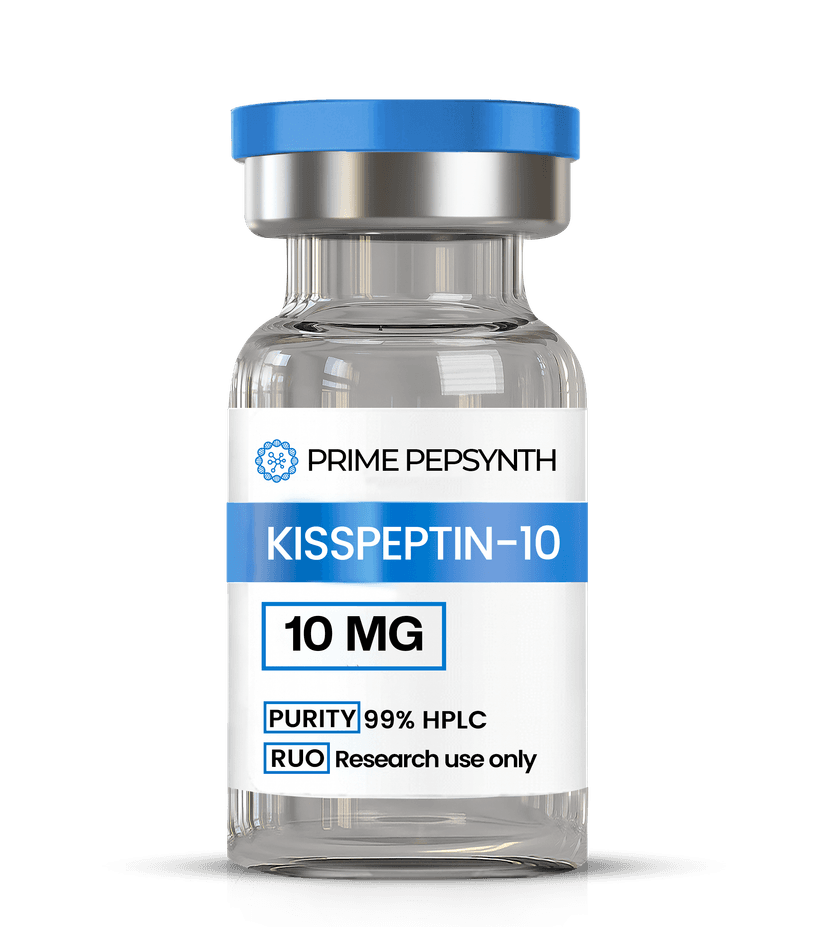
Kisspeptin-10 is a synthetic decapeptide (Tyr-Asn-Trp-Asn-Ser-Phe-Gly-Leu-Arg-Phe-NH₂) corresponding to the active fragment of the KISS1 gene product. It binds to the GPR54 (KISS1R) receptor, activating Gq-mediated signaling cascades and modulating gonadotropin-releasing hormone (GnRH) expression in preclinical studies. Kisspeptin-10 serves as a tool for exploring reproductive and neuroendocrine peptide signaling.
For research use only. Not for human consumption.
References:
Kotani M et al., J Biol Chem, 2001 276(37):34631–34636
Oakley AE et al., Endocr Rev, 2009 30(6):713–743
de Roux N et al., N Engl J Med, 2003 349(17):1614–1627
What is Kisspeptin-10?
Kisspeptin (a.k.a. metastin) is a naturally occurring protein in humans tnat
plays important roles in hormone signaling during puberty and
reproduction. It is also thougnt to alter mood and behavior, promote
angiogenesis, and regulate kidney function. The peptide has also been
found in the brain and is known to suppress tumor growth and metastasis
(spread). The peptide is of greatest scientific interest for its ability to
influence gonadotropin releasing hormone (GnRH).
Kisspeptin-10 Structure
sequence: YNWNSFGLRF
Molecular Formula: C63H83N17014
Molecular Weight: 1302.4 g/mol
PubChem CID: 25240297
Synonyms: KISS-I, Protein KISS-I, metastin, Kp-10 peptide
Kisspeptin-IO Research
Boosting Gonadotropin-Releasing Hormone
Gonadotropin-releasing hormone (GnRH) is synthesized in and released
from GnRH neurons in the hypothalamus. It is the first hormone released
in the hypothalamic-pituitary-gonadal axis and controls the release of
follicle-stimulating hormone (FSH) and luteinizing hormone (LH) from the
anterior pituitary gland. GnRH is the primary driver ot puberty and controls
the maturation of gametes in the genitals. It is used therapeutically to
control menstruation in select settings, as a treatment for precocious
puberty, and as a continuous infusion in certain types of cancer
Increasing Testosterone
By affecting circulating levels of LH and FSH, kisspeptin can alter
testosterone levels- This alteration, however, appears to be sex specific. In
men, kisspeptin increases testosterone levels while in women it has no
discernible impact on testosterone. In one study, 6 men were administered
a derivative of kisspeptin via IV. They showed a significant increase in
plasma testosterone levels (nearly 3-fold) after just 90 minutes[l]. A
different analog of kisspeptin has been found to alter the pulse frequency
of LH in men, suggesting that kisspeptin helps to fine tune the normal
pulsatile release of sex hormones. A study of healthy men given
kisspeptin-10 revealed a rapid and dose-dependent increase in serum LH
levels and a concomitant increase in testosterone levels. Kisspeptin-10
appears to achieve this feat by increasing the pulsatile release of LH. If
given at high enough doses, kisspeptin-10 causes such rapid pulsation as
to obscure individual pulses entirely, resulting in continuous LH release[2].
This finding opens the door for potential uses of kisspeptin and its
analogues in a variety of settings from pregnancy to low testosterone
levels and more.
Energy Balance
Kisspeptin neurons have long been known to be sensitive to the energy
status of an individual. Both under-nutrition and severe over-nutrition can
blunt the action of kisspeptin neurons in stimulating GnRH release. In fact,
drastic changes in energy balance can lead to infertility in both men and
women, a process that appears to be mediated by kisspeptin.
So it is well understood that kisspeptin production and release is sensitive
to energy balance. What is becoming clearer, however, is that kisspeptin
may itself regulate energy balance. This finding arose through the
observation of mice in which the kisspeptin receptor (Kisslr) was removed
via genetic manipulation. These mice showed increased adiposity and
reduced energy expenditure. It turns out that the kisspeptin receptor is
found in adipose (fat) tissue and brown adipose tissue[3]. It should not
come as a surprise that kisspeptin plays a role in energy balance as
energy status and reproductive fitness have always been tightly linked. It
seems that kisspeptin may be one link that helps to explain the
neurochemical control that leads to energy modulating behavior in relation
to reproduction.
Cancer Research
Twenty years ago, it was discovered that kisspeptin is capable of
suppressing metastasis of melanoma (malignant skin cancer) by as much
as 95%- It appears that the peptide produces this effect by reducing
cancer cell migration- There is also some question as to whether
kisspeptin can reduce cell adhesion and thereby prevent cancer cells from
sticking to other tissues and invading them. Screening of a variety of
metastatic cancer types reveals that breast, bladder, GI, prostate,
pancreatic, ovarian, skin, and thyroid cancers all show changes (generally
decreases) in kisspeptin levels, confirming that the peptide plays a role in
the spread of cancer141.
Studied Memory Enhancement
It appears that certain analogs to kisspeptin are important in the areas of
the brain responsible for memory consolidation and orientation in 3-D
space. Research in mice suggests that administration of these peptides
can help to reverse the learning and navigational impairment often seen in
ethanol intoxication[7]. This suggests that kisspeptin and its analogues
play a role in the ability Of neurons to encode intormation and may make
these peptides of potential interest in offsetting learning deficits seen in
certain genetic and chronic disease situations. While this research is in its
early stages, it helps to widen our understanding of learning and push us
further toward the development of nootropics that can help to stimulate
both health and damaged brains to improve function.
Article Author
The above literature was researched, edited and organized by Dr. E.
Logan, M.D. DC E. Logan holds a doctorate degree from Case Western
Reserve University School of Medicine and a B.S. in molecular biology.