
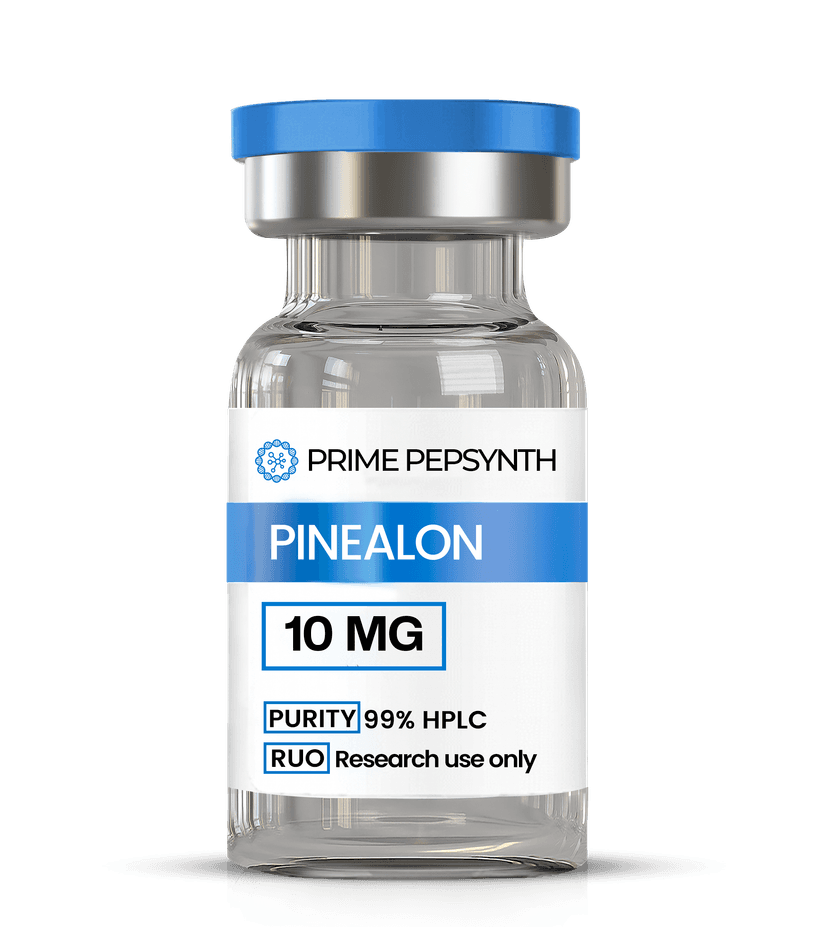
Pinealon is a synthetic tripeptide (Glu-Asp-Arg) that has been investigated for its potential to regulate neuronal differentiation and oxidative-stress responses. Preclinical models demonstrate its influence on mitochondrial enzyme activity, neuroprotective signaling, and gene expression linked to synaptic plasticity. Pinealon serves as a research model for understanding peptide-mediated control of energy metabolism and neural cell homeostasis.
For research use only. Not for human consumption.
References:
Anisimov VN et al., Biogerontology, 2010;11(2):139–149
Linkova NS et al., Neurochem J, 2017 11(2):120-126
Trofimova SV et al., Adv Gerontol, 2015 28(3):432-439
What Is Pinealon?
Pinealon is a shott peptide consisting of just three amino acids. It is one of a
handful of syntneüc peptides referred to as peptide bioregulators for their ability
to interact directly with DNA to alter gene expression levels. Pinealon has been
linked to behavior modification and is thought to help protect a number of cell
types, including neurons, against the effects of hypoxia. By direct effect on the
pineal gland, pinealon may reduce problems with drug metabolism, circadian
rhythm disorders, memory, learning, and more.
Pinealon Structure?
Sequence: Glu-Asp-Arg
Molecular Formula: C15H26N€08
Molecular Weight: 418.407 g/mol
PubChem CID: 18220191
Synonyms: Glutamylaspartylarginine, T-33 peptide
Pinealon Interacts Directly with DNA
I-Jnlike most peptides, pinealon does not appear to bind to cell surface or
cytoplasmic receptors. This has led scientists to wonder how the shon peptide
can nave any effect. In the past, it was suggested that pinealon may be small
enough to cross lipid bilayers (e.g. the cell membrane, nuclear membrane) and
may therefore be able to interact directly with DNA Testing in cell cultures
(HeLa cells) indicates that pinealon directly penetrates the cell membrane as
well as the nuclear membrane to interact with DNA[I]. This makes pinealon a
regulator of gene expression and explains the peptide's myriad effects that
cannot be explained by receptor interactions.
Pinealon Research
Pinealon Research and Aging
Pinealon may have anti-aging effects in the central nervous system. Research
from Russia indicates that pinealon and a similar peptide, vesugen, are
anabolic in the brain and can actually slow the rate of aging when calculated
using biological age indicators[2].
Pinealon is active in cells outside of the central nervous system as well.
Research shows that the peptide also has effects on muscle cells where it
alters the expression of irisin[2]. Irisin is important to protecting muscle cells
during exercise, promotes fat buming, and is thought to induce telomere
elongation as well. By increasing the lifespan of irisin, pinealon boosts telomere
protection and helps to fight off the effects of aging and oxidative stress. In fact,
plasma irisin levels are directly linked to telomere length in healthy adults and
levels of the enzyme have been directly linked to calorie restriction, one of the
few activities known beyond doubt to prolong life and improve overall fitnessff].
Interestingly, there is evidence that irisin is active outside of muscle cells and
that pinealon may therefore have anti-aging effects that are broadly distributed
throughout the body, including the brain
Pinealon Research and Neuron Protection
Research in prenatal rats indicates that pinealon protects neurons against
oxidative stress and thus protects cognitive function and motor coordination[6]-
The study showed marked decreases in both reactive oxygen species
accumulation as well as number of necrotic cells in the brain in these rats. In
other words, pinealon protects neurons from dying.
The findings of the prental rat study disc.l Issed above have been confirmed in
separate studies and extended in others. Confirmation that pinealon protects
against reactive oxygen species and reduces necrotic cell death also came with
the understanding that the peptide modifies the cell cycle as pan of its
protection against cell deathP]. This was one of the first indications that
pinealon was almost certainly interacting at the level of DNA. Interestingly,
pinealon modulates the cell cycle by activating proliferation pathways. Under
normal circumstances, this would lead to an increase in cell number, but under
the setting of oxidative stress, this effect simply offsets some of the damaging
effects of reactive oxygen species.
Research in adult rats deprived of oxygen has also shown that pinealon
increases the resistance of neurons to hypoxic stress. It appears to do this by
stimulating innate ant-oxidative enzyme systems and limiting the excitotoxic
effects of N-methYl-D-aspanate[71. N-methyl-D-aspanate (NMDA) is an amino
acid derivative that can kill nerve cells by over-exciting them. NMDA has been
shown to become overactive during withdrawal trom alcohol and is at least
partly responsible for the "shakes" or delirium tremors that affects chronic
alcoholics during withdrawal. NMDA has been linked to nerve death in traumatic
brain injury and ischemic stroke..
Irisin, which has been discussed in the context of muscle cell protection, has
recently been found in the brain where it plays important roles in neural
differentiation, proliferation, and energy expenditure. Irisin levels in the central
nervous system has been found to stimulate genes in the hippocampus that are
important to memory, learning, the overall neuron health[el. Research in rats
suggests that exercise directly boosts levels of irisin in the brain, which may
finally provide the link between physical activity and cognition. Scientists have
speculated that irisin is the messenger that mediates crosstalk between skeletal
muscle and the central nervous system during exercise. Pinealon boosts levels
of irisin by altering expression of the gene that codes for the enzyme. This leads
to increased levels of irisin through prolonged lifespan of the enzyme.
Pinealon research and Depression
Research in cultures of brain cortex cells indicate that pinealon can boost
expression of 5-tryptophan hydroxylase via epigenetic changes. 5-tryptophan
hydroxylase is critical to the production and secretion of serotonin, a peptide
known to have neuroprotective and geroprotective features[e]. It is also the
signaling molecule most often targeted by anti-depressive drugs called
selective-serotonin reuptake inhibitors (SSRIs). SSRIs have a number of side
effects, however, and the ability to boost serotonin production organically could
offer a means of fighting depression that is more physiologic and thus reduce
side effects.
Pinealon Protects Cells from Caspase-3 and Cell Death
The initial understanding that pinealon could affect the cell cycle came from
research into the effects of the peptide in rat models of ischemic stroke. These
studies revealed that pinealon affects cytokine signaling that normally leads to
an increase in levels of the caspase-3 enzyme[101. Caspase-3 is directly
responsible for initiating apoptosis, or the controlled death of a cell via genetic
instruction. By modulating caspase-3, pinealon shuts down at least one
pathway to cell death and thus reduces the effects of oxygen deprivation during
stroke.
Caspase-3 is not only active in neurologic tissue though, it is almost universal.
Research using models of healt attack indicates that pinealon may reduce
caspase-3 levels following myocardial infarction(lll. The short peptide may have
application both in treating heatl attack and in preventing the long-term
remodeling that causes so much dysfunction following a myocardial infarction.
The benefit of pinealon in suppressing caspase-3 expression has been
demonstrated in Skin cells. By reducing apoptosis in the skin, pinealon
promotes cell proliferation in both young and old animals alike. This leads to an
increase in the regenerative process and nas been snown to offset age-related
pathology in the skin['2]. Pinealon may eventually form part of a multi-faceted
approach to wound healing and could have application in everything from sun
protection to serious bum treatment.
Pinealon Research and Sleep Regulation
It should come as no surprise, given its names, that pinealon affects that sleep-
wake cycle as well as sleep behavior. Research indicates, that pinealon may
help to regulate the dysfunction caused by shift-work and other activities (e.g.
long-distance travel) that interfere with normal sleep patterns The peptide
actually appears to reset the pineal gland to baseline in the setting of circadian
rhythm disruption, improving Sleep, depression, mood, b100d pressure, and
more as a result[131.
The ability to regulate sleep actually corresponds strongly with rates of aging.
Disturbed sleep is a recipe for disaster in the body and affects cognition,
cardiac health, wound healing, mood, and more. Pinealon may therefore help to
reduce the impact of sleep disturbance and thus offset the effects that it has on
aging. This could be beneficial not only to those forced into disorder sleep due
to their jobs, but to individuals suffering from organic disease that impacts
sleep-wake cycles.
Pinealon exhibits minimal side effects, low oral and excellent subcutaneous
bioavailability in mice. Per kg dosage in mice does not scale to humans.
Pinealon for sale at Peptide Sciences is limited to educational and scientific
research only, not for human consumption. Only buy Pinealon if you are a
licensed researcher.
Article Author
The above literature was researched, edited and organized by Dr. Logan, M.D.
Dc Logan holds a doctorate degree from Case Western Reserve University
School of Medicine and a B.S. in molecular biology.