
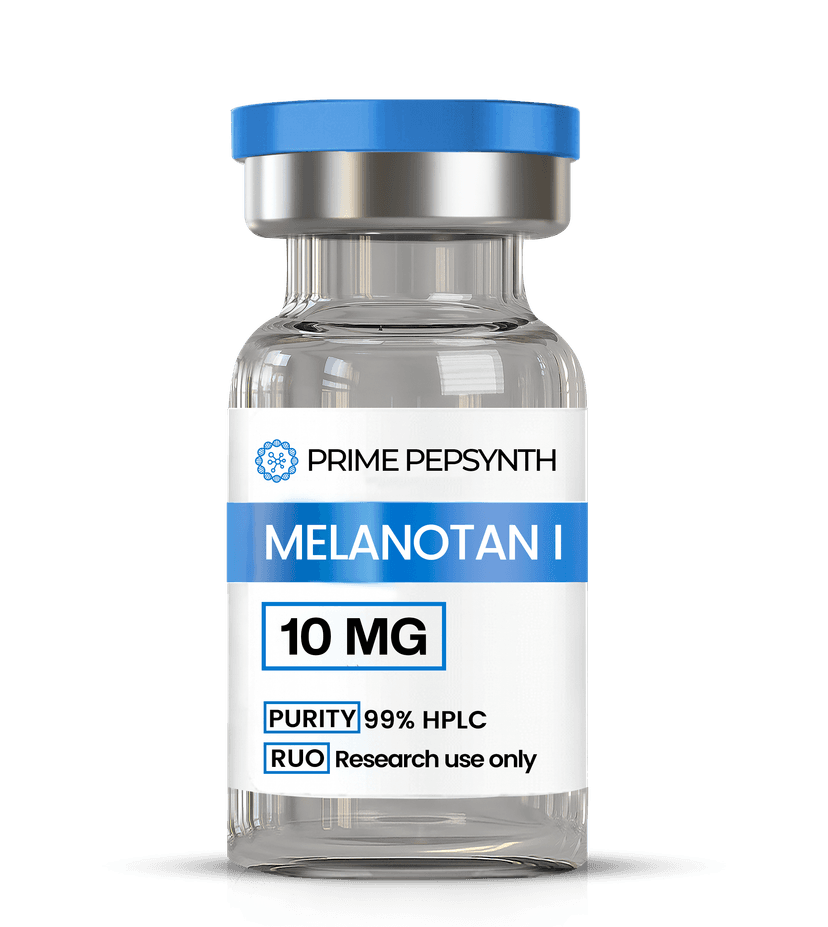
Melanotan 1 is similar to naturally occurring alpha melanocyte stimulating hormone alpha-MSH (Melanotan 2). Alpha-MSH is known for its influence on melanocytes, the cells in skin and hair responsible for pigmentation. This function is mediated via strong binding to melanocortin receptor 1. Alpha-MSH is a non-selective full agonist of melanocortin receptors 1, 3, 4, and 5. Melanotan 1 differs from alpha-MSH (Melanotan 2) by a single amino acid and was actually first developed as a sunless tanning agent. Research into melanocortin receptors and their effects, scientists quickly discovered that while melanotan 1 did indeed cause pigmentation, and altered baseline metabolism. Subsequent study of melanotan 1 and other melanocortin-binding proteins helped scientists to better understand the melanocortin signaling system.
What Is Melanotan 1?
Melanotan 1 is a synthetic analogue of alpha-melanotocyte stimulating
hormone. It is used clinically, in Europe, to prevent sun-related skin damage
(i.e. phototoxicity) from occurring in people suffering from erythropoietic
protoporphyria. Though initially developed as a sunless tanning agent,
melanotan 1 has been found to have a number ot physiologic effects on blood
pressure, teeding behavior, central nervous system function, and more. The
peptide is in phase 3 clinical trials for the treatment of polymorphose light
eruption and is in phase 2 clinical trials for the treatment of actinic keratosis (a
specific type of skin damage caused by the sun) and its more serious
counterpart, squamous cell carcinoma.
Melanotan 1 Structure
Sequence. Ser-Tyr-Ser-Nle-Glu-His-D-Phe-Arg-Trp-Gly-Lys-Pro-Val
Molecular Formula-
Molecular Weight 1646.874 g,/mol
PubChem CID. 16154396
CAS Number 75921-69-6
Synonyms:
Afamelanotide, Scenesse, CUV1657, MT-I
How Does Melanotan 1 Work?
Melanotan 1 is very similar to naturally occurring alpha melanocyte stimulating
hormone (alpha-MSH). Alpha-MSH is primarily known for its influence on
melanocytes, the cells in skin and hair responsible for pigmentation. This
function is mediated via strong binding to melanocortin receptor 1. Alpha-MSH
is a non-selective full agonist of melanocortin receptors I , 3, 4, and 5.
Melanotan 1 differs from alpha-MSH by a single amino acid and was actually
first developed as a sunless tanning agent. Research into melanocottin
receptors and their effects was relatively limited at the time and scientists
quickly discovered that while melanotan 1 did indeed cause pigmentation, it
also increase sexual arousal, boosted appetite, and altered baseline
metabolism. Subsequent study of melanotan 1 and other melanocortin-binding
proteins helped scientists to better understand the melanocortin signaling
system.
Melanotan 1 Research
Melanotan 1 Originally Designed for Sunless Tanning
MT-I has been studied in phase 1 clinical trials for its effect on tanning in
humans exposed to ultraviolet radiation. The research showed that subjects
administered MT-I were 75% more likely to tan and 47% less likely to
experience sunbum. Compared to controls, subjects given melanotan I
required 50% less exposure to ultraviolet light to achieve equivalent tanning.
They also retained their tan for three weeks longer than those exposed only to
UV light[l]_ There is some thought among scientists that melanotan I could be
used to boost tanning in high UV settings to protect against sunburn and the
long-term effects of ultraviolet skin damage. This could be particularly useful in
individuals with poor-tanning skin types (referred to as type I and type II by the
Fitzpatrick scale).
Research in individuals With variant MCI receptors shows that they are less
likely to tan than the average individual. As it tums out, administration of
melanotan 1 in this setting increases melanin density and tanning substantially,
helping to protect people who do not tan well and are most in need of
photoprotection[2]_ These are individuals who get limited benefit from sunscreen
and, in order to prevent skin cancer, must limit their sun exposure a great deal.
This research could open pathways to better UV protection and reduce rates of
skin cancer substantially.
There is also interest in using melanotan 1 to treat vitiligo. A small phase 1 trial
showed that using melanotan 1 in conjunction with LJVB light therapy stimulated
both melanin production and the proliferation of the melanocytes that produce
melanin. Nearly half of treated patients showed improved pigmentation of
vitiligo lesions and a faster rate of repigmentation[31. Research shows that
combining melanotan 1 treatment with existing treatment modalities of vitiligo
produces synergistic effects and improved aesthetic outcomes in shorter
periods of time[41. If successful in vitiligo treatment, there may be applications
for melanotan 1 treatment in the setting of hypopigmented scars, etc
Actinic keratosis, also called solar keratosis, is a crusty scaly growth of skin
caused by overexposure to IJV light. It is considered a precancerous lesion that
will eventually lead to squamous cell carcinoma (one type of Skin cancer) if left
untreated. There are more than 400,000 cases every year. Though obvious
lesions can be removed by a dermatologist or surgeon, the vast majority are so
small that they cannot be seen or even felt. Melanotan 1 is being investigated
as a possible first-line agent tor treating these invisible lesions and tor
preventing their progression to full-blown skin cancer.
Melanotan-l Research and Blood Pressure
Research in hypertensive (high blood pressure) mice has revealed that
melanotan 1 can protect against high blood pressure without affecting animals
that have normal blood pressure[51. This is important because current blood
pressure medications can cause hypotension, which can lead to loss of
consciousness, stroke, heart attack, and more. This side effect of blood
pressure medications is more common in the elderly, thanks in part to their
labile physiology- The ability to regulate high blood pressure without causing
significant lows makes melanotan 1 the perfect candidate for exploring further
drug development.
Cognitive Decline, Alzheimer's Disease, and Melanotan 1
Research in transgenic mice indicates that melanotan 1 may protect the brain
against the kind of damage that leads to cognitive decline and Alzheimer's
disease. The study, which used a mouse model of moderate Alzheimer's
disease (AD), indicated that melanotan I, even in minuscule doses, reduces
the level of amyloid beta plaques in the brain, protects neurons from death, and
improves Clinical measures of cognitive function as well as laboratory measures
of synaptic transmission. In the same study, blocking the effects of melanotan I
at the MC4 receptor prevented all of the peptide's favorable effects[d].
The benefit of melanotan I action at the MC4 receptor has been explored in
other studies as well. Research, also in mice, shows that MC4 receptor
stimulation can boost neurogenesis and lead to cognitive recovery in AD. It is
one of the few studies to show improvement in the condition rather than simply
slowing decline[71. Once daily administration of MT-I reduces levels of all AD-
related biomarkers, indicating that the peptide actually works through multiple
pathophysiological pathways[:].
The MC4 receptor is the only melanocortin receptor known to be expressed on
astrocytes, the cells that protect neurons and provide them with nutrition.
Research in rats indicates that melanotan I improves astrocyte functioning by
increasing levels of brain-derived neurotrophic factor (BDNF)P]_ BDNF is critical
to protecting synapse stability and neurogenesis in general.
Melanotan 1 and Functional Recovery Following Stroke
It isn't just biomarkers in AD that improve following MT-I treatment. Research in
gerbil models of a stroke lasting ten full minutes reveals that treatment with
nanomolar doses of melanotan 2 can reduce brain damage, including neuron
death, and improve recovering of learning and memory. What is really exciting
is that these effects are achieved even melanotan 1 is administered 9 hours
aner a stroke1101. It iS thought that MT-I activates repair mechanisms that
improve synaptic plasticity and promote long-lasting functional recovery by
allowing the brain to reroute learning and memory to healthier areas. The lynch
pin in this process appears to be expression of the Zif268 gene. Zif268 is over-
expressed in animals given melanotan-l. The same gene is also over-
expressed in the models of Alzheimer's disease showing cognitive
improvement.
Melanotan 1 Influences Heart and Circulation
Research in rats undergoing heart attack has shown that melanotan 1 and
other melanocortins can help to reduce injury and improve circulatory
parameters. Administration of MT-I during CPR and in conjunction with
epinephrine helps to restore baseline arterial pressure and heart rate, reverses
metabolic acidosis, reduces inflammatory markers, and improves the
expression of genes associated with cardiac function. Overall, the therapy
improved survival rate by 81%, a substantial increase that may make
melanotan 1 or a similar melanocortin a mainstay of emergency advanced
cardiac life support[lll.
Melanotan 1 Research and Neuroinflammatory Disease
Research on melanotan 1 has revealed that the MCI receptor is responsible for
pigmentation in skin and hair- For a long time it was thought that this was the
receptor's only function. Recent research in mice, however, has indicated that
this receptor plays a role in mediating inflammation in the central nervous
system. In multiple sclerosis, for instance, helper T cells cause loss of myelin on
neurons, which in tum causes neuron dysfunction and even death. In mice,
administration of melanotan I interferes with this process and prevents loss of
meylin, thus preventing neuron damage. In fact, administration of MT-I to these
mice improved myelin recovery and helped to reestablish neuron signaling[121.
Similar effects as above are also seen in mouse models ot uveitis, an
inflammatory disorder of the eye that can cause pain and vision loss. Current
treatments have a range of side effects, so scientists are constantly searching
for alternatives to steroids and immunosuppressive drugs. Alpha-MSH acts to
suppress T-cell function, a property mediated through the MC4 receptor and
thus mimicked by MT-1[131. Surprisingly, local administration of MC4 receptor
agonists directly to the eye is as effective as systemic administration. This route
of administration helps to eliminate systemic side effects.
Melanotan 1 Investigated in Fat Loss Trials
Melanotan 1 works on several melanocortin receptors, including the MC5
receptor. Stimulation of MC5R promotes the oxidation of fatty acids by muscle
and shifts fat cells from fat storage to fat buming[14], [15]. These findings in mice
also reveal that the fat buming caused by melanocortin stimulation is complex
and involves several receptors and physiologic pathways. That said, melanotan
1 is useful to scientists wishing to explore how fatty acid metabolism can be
altered and offers the tantalizing ability to boost baseline physiology without the
need for exercise, which could be of tremendous benefit in individuals who are
unable to exercise due to morbid obesity, disability, or injury.
About The Author
Research by L. Edmiston, M.D. for Peptide Sciences. L Edmiston holds an
M.D. from Case Westem Reserve University School of Medicine and a B.S. in
molecular biology.