
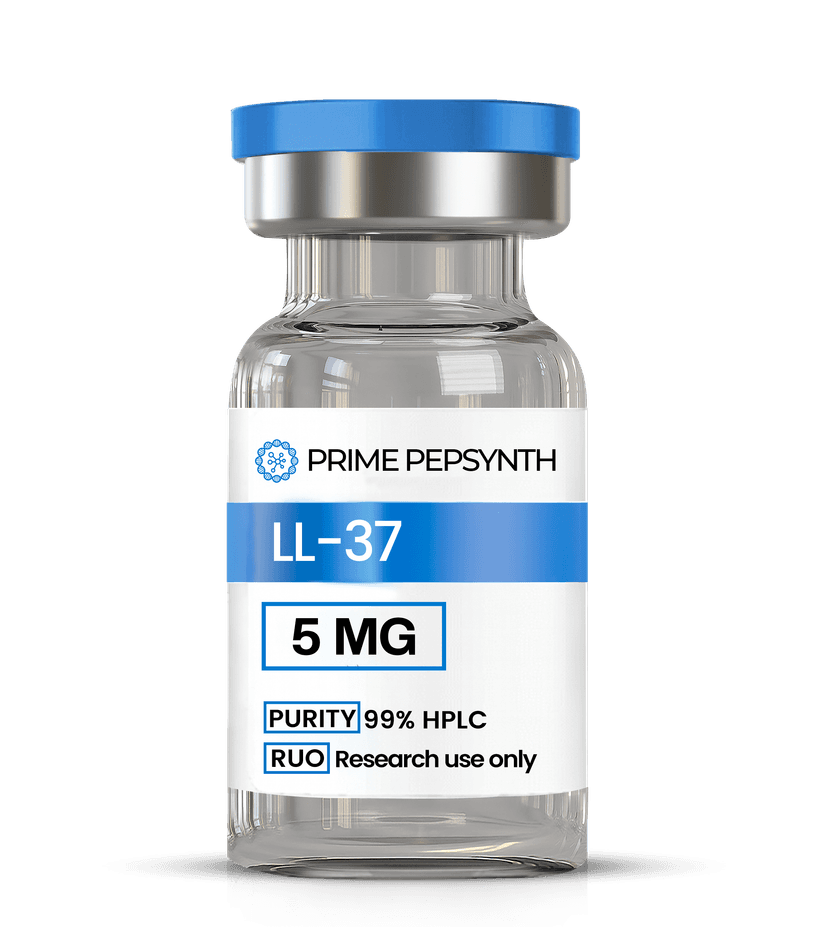
LL-37, Like all Cathelicidins, has antimicrobial, antibacterial, antiviral, anti-fungal and has been shown to reduce inflammation. Research has also shown that its effect against certain cancers and encourages blood vessel growth in specific settings.
What Is LL-37 (CAP-18)?
LL-37 is the only known human cathelicidin, which is a large protein family with diverse function- These
peptides, which are primarily found in macrophages and polymorphonuclear leukocytes (both types of
white blood cell), are important for killing bacteria, but have been found to have other dramatic effects as
well. The entire class is often referred to as antimicrobial peptides (AMPS). LL-37 has been found to play
important roles in autoimmune disease, cancer, and wound healing.
LL-37 Structure
Sequence: -Leu-Leu-Gly-Asp-Phe-Phe-Arg-Lys-Ser-Lys-Glu-Lys-lle-Gly-Lys-Glu-Phe-Lys-Arg-lle-Val-Gln-
Arg-lle-Lys-Asp-Phe-Leu-Arg-Asn-Leu-Val-Pro-Arg-Thr-Glu-Ser
Molecular Formula: C2D5H„aNE0053
Molecular Weight 4493.342 gtmol
PubChem CID: 16198951
CAS Number. 154947-66-7
Synonyms: CAP-18, Cathelicidin, antibacterial peptide LL-37
LL-37 Research
LL-37 and Inflammatory Diseases
LL-37, while primarily billed as an antimicrobial peptide, actually plays a role in a number of inflammatory
diseases such as psoriasis, lupus, rheumatoid arthritis, and atherosclerosis. Depending on the local
inflammatory environment and the particular cells involved, LL-37 has several different immune system
modulating behaviors. It has been found to:
• decrease keratinocyte apoptosis,
• increase IFN-aIpha production,
• alter chemotaxis of neutrophils and eosinophils,
• down-regulate signaling through toll-like receptor 4 (TLR4),
• increase IL-18 production, and
• decrease levels of atherosclerotic plaques[ll.
Interestingly, LL-37 does not affect the immune system in the same way all of the time- Research in cell
culture has shown that the inflammatory environment affects how cells of the immune system respond to
LL-37. T-cellS, for instance, Will increase their inflammatory actions in response to LL-37 when they are not
activated but decrease inflammatory action men already activated[21. It appears that LL-37 nas potent
homeostatic effects, helping to balance the immune response and prevent it from becoming overactive in
the setting of infection. These findings would suggest that LL-37 could play a role in helping to regulate the
unchecked inflammation of autoimmune diseases. This may explain why there has been a strong
correlation between LL-37 levels and autoimmune disease. It was previously thought that LL-37 might be
causing autoimmune inflammation, but more recent evidence suggests that high levels of LI--37 in
autoimmune disease may actually be preventing more fulminant inflammation.
LL-37 Is a Potent Antimicrobial
LL-37 is part of the innate immune system and as such is one of the first pieces of the immune system to
be activated during infection. Research in skin infections suggests that normal skin has very low levels of
LL-37 but that the peptide accumulates rapidly in the presence of invading pathogens. The peptide has
been shown to work in tandem with other proteins, like human beta-defensin 2 to combat infection[3].
LL-37 primarily works by binding to bacterial lipopolysaccharide (LPS), a major component of the outer
membrane ot gram-negative bacteria. LPS iS a critical component ot membrane integrity in these bacteria.
The ability of LL-37 to bind to and interfere with LPS means it is exceptionally deadly to certain bacteria.
There is interest in using the peptide exogenously to treat serious bacterial infections in people[41_
Despite the fact that LL-37 acts on the cell membrane components of gram-negative bacteria, it still has
potent gram-positive effects as well. This could make it a beneficial treatment for staph infections and
other serious bacteria. In vitro research indicates that LL-37 enhances the effects of lysozyme, an enzyme
responsible for the destruction ot gram positive bacteria like Staph aureus[5].
LL-37 and Lung Disease
LPS, as mentioned above, is not unique to bacterial cell walls. It is found in a number of different
organisms and, in some cases, becomes airbome wnen an environment is contaminated by mold or other
fungi. When LPS is inhaled, normal lung tissue responds by producing. I-Jnfonunately, the response is
often inadequate to prevent toxic dust syndrome and the pathogenesis of respiratory diseases like
asthma, COPD, and more. Research into the use of LL-37 as an inhaled treatment for toxic dust
syndrome is currently under way[å].
One ot the interesting findings of research into the effects of LI--37 on lung disease is that the peptide
promotes epithelial cell proliferation and wound closure. It appears that one of the primary properties of
LL-37, at least in the lungs, is to attract air,vay epithelial cells to the site of injury and promote both wound
healing and the growth of blood vessels necessary for providing nutrients to the new tissue. It seems that
LL-37 is an important homeostatic regulator in the aimays just as it has been found to be a homeostatic
regulator of immune function[7].
Understanding LL-37 in Arthritis
Research in rats indicates that LL-37 is found in high concentrations in joints affected by rheumatoid
arthritis. In particular, the peptide appears to be associated with the pathological events of arthritis. It isn't
clear, however, if the peptide is causative or its up-regulation in these joints is a part of the body's attempt
to control the pathological process[!]. Several things, however, suggest that LL-37 is beneficial in
inflammation and not causative.
First, there iS no evidence that LL-37 or any other cathelicidin is involved in the pathogenesis of
inflammatory disease. This does not rule the peptide out as being causative, the but evidence weighs
pretty heavily against that being the case. In particular, LL-37 deficiency does not affect outcomes in
animal models of amritis or lupus. In other words, animals without LL-37 experience the same
pathological progression as animals who have the peptide. Based on these findings, scientists have
suggested that reactivity against cathelicidins in arthritis is likely an epiphenomenon that results from
extensive over-expression of the peptide in inflamed tissues[g]. In other words, it is incidental.
Research in mouse models of arthritis indicate that peptides derived from LL-37 confer protection against
collagen damage that often occurs in inflammatory arthritis. Administration of these peptides directly to
affected joints decreases the seventy of disease as well as serum levels of antibody against type II
collagens[10]. Based on this study, it is reasonable to speculate that LL-37 probably has protective activity
in arthritis, which could explain its high concentrations in tissues with substantial inflammation. This
speculation is supported by the fact that LL-37 and its derivatives have been shown to regulate
inflammation caused by interleukin-32, a molecule that has been directly associated with severity of
inflammatory arthritis[lll.
Arthritis has also been associated with an up-regulation of toll-like receptor 3 in the fibroblasts of synovial
fluid, a factor that likely aggravates arthritis by increasing inflammatory cytokine levels[121. LL-37 has been
shown to bind to TLR4 and either promote pro-inflammatory or anti-inflammatory effects- VMhich it does in
the setting ofTLR3 up-regulation isn't clear, but research is ongoing. The idea that it might reduce
inflammation selectively is not unreasonable given that LL-37 has been found to selectively reduce pro-
inflammatory macrophage responses in the past[13].
LL-37 and the Intestine
Research in cell cultures indicates that LL-37 has several effects in the intestine. First, the peptide
increases migration of cells necessary for maintaining the epithelial barrier ot the intestine. Second, LI--37
reduces apoptosis in the setting of intestinal inflammation, helping to slow the pathogenesis of a number
of inflammatory conditions. Overall, the research indicates that LL-37 may be a useful adjuvant treatment
in inflammatory bowel conditions, following intestinal surgery, or in the setting of acute intestinal infections.
It may even prove useful as an adjuvant to antibiotic therapy, helping to prevent the GI side effects that
often limit oral antibiotic use[14].
LL-37 does not work alone in the intestine, pairing once again with human beta defensin 2 to promote
wound healing. Research in cell culture indicates that the peptides work in tandem to both repair and
maintain intestinal epithelium while reducing TNF-related cell death[15]. Currently, TNF-alpha inhibitors are
a mainstay of treatment for inflammatory bowel conditions- They are effective drugs, but have a number of
serious side effects including causing a drastic increase in the risk of serious infection, such as
tuberculosis- The development of LL-37-based treatments of inflammatory bowel disease could help to
reduce reliance on TNF-alpha inhibitors and improve morbidity and mortality in this patient population.
LL-37 and Intestinal Cancer
Research regarding LL-37 and cancer has produced mixed results, but the peptide appears to be
beneficial in the setting of intestinal and gastric cancers, including oral squamous cell carcinoma
associated with smoking and tobacco use- Interestingly, these effects appear to be mediated by a vitamin-
D dependent pathway, which may explain why taking the vitamin has been previously associated with a
reduced risk for GI cancer. It appears that vitamin D induces the anti-cancer activity of tumor-associated
macrophages via LL-37[10].
LL-37 and Blood Vessel Growth
LL-37 appears to trigger the synthesis of prostaglandin E2 (PGE2) in endothelial cells. PGE2 is associated
with both inflammatory' pain and with the growth of blood vessels, but these effects differ based on where
the molecule is being expressed. In endothelial cells, PGE2 triggers the development of blood vessels in a
process called angiogenesis[171. This can be both good and bad, depending on the particular setting. The
ability to regulate angiogenesis has been the focus of much research in the last several decades because
it impacts cancer development, heart disease, stroke outcomes, wound healing, and more. LL-37 activity
offers a useful means for probing the angiogenesis pathway as well as a model for potential future
interventions to both promote blood vessel grov,'th when needed (e.g. heart disease) and discourage it
when it is detrimental e. . cancer .
Ongoing LL-37 Research
One of the interesting things about LL-37 is that it has a different structure in humans than in other
mammals[181. These altemative structures result in different functions for the same basic peptide and
provide insight into how three-dimensional configuration can impact receptor binding. This feature makes
LL-37 of intense interest because it allows scientists to study the impacts of simple amino acid sequence
changes on structure and ultimately function. This could inform an entire branch of biochemistry and make
it easier tor scientists to manipulate protein production to achieve very specific results
LL-37 exhibits minimal to moderate side effects, Iow oral and excellent subcutaneous bioavailability in
mice. Per kg dosage in mice does not scabe to humans. LL-37 for sale at Peptide Sciences is limited to
educational and scientific research only, not for human consumption. Only buy LL-37 if you are a licensed
researcher.
Article Author
The above literature was researched, edited and organized by Dr. Logan, M.D. Dr. Logan holds a
doctorate degree from Case Westem Reserve University School of Medicine and a B.S. in molecular
biology.
Scientific Journal Author
Daniela Xhindoli, PhD. operates from the University of Trieste, UNITS Department of Life Sciences. Her
focus surrounds gram-negative bactena, the biological activities of LL-37 on simultaneously modulating
pro-inflammatory and anti-inflatjonary pathways, and the antibactenal and antimicrobial effects of LL-37.
Daniela Xhindoli, PhD. iS being referenced as one of the leading scientists involved in the research and
development of LL-37. In no way is this doctor/scientist endorsing or advocating the purchase, sale, or use
of this product for any reason. There is no affiliation or relationship, implied or otherwise, between Peptide
Sciences and this doctor. The purpose of citing the doctor is to acknowledge, recognize, and credit the
exhaustive research and development efforts conducted by the scientists studying this peptide. Daniela
Xhindoli, PhD is listed in [18] under the referenced citations.