
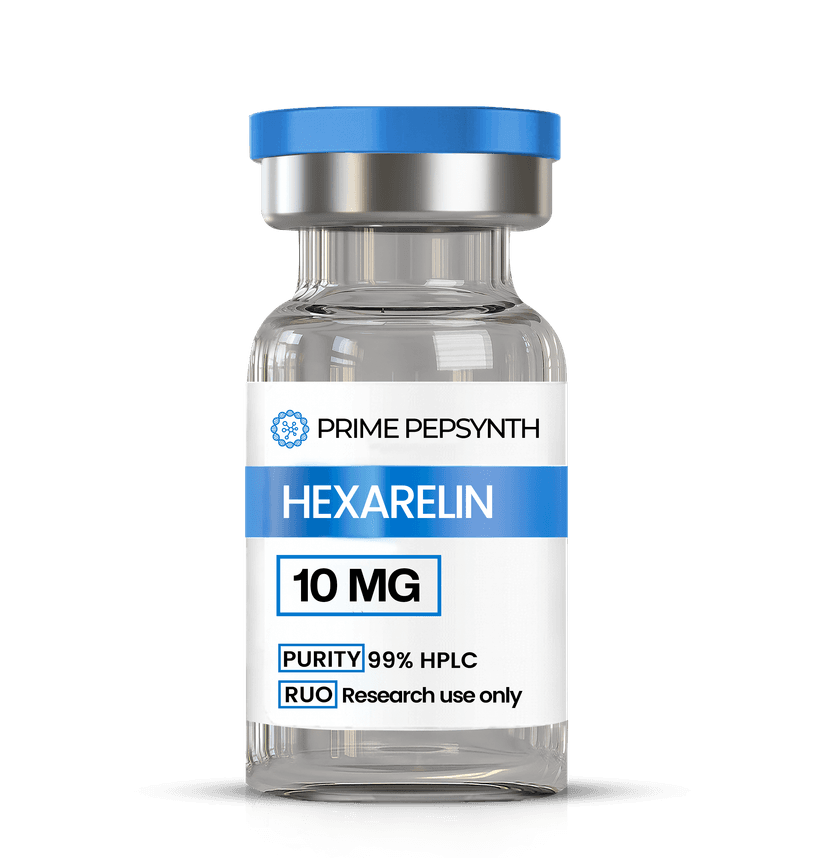
Hexarelin is a synthetic analogue of ghrelin that shows benefit in heart disease and cardiac ischemia, protecting the heart following heart attack. Research has shown that Hexarelin also protects skeletal muscle against wasting and improves cholesterol and triglyceride levels.
What Is Hexarelin?
Hexarelin, also called Examorelin, is a synthetic analogue of ghrelin and is
closely related to GHRP-6. In fact, hexarelin and GHRP-6 differ from each
other only slightly thanks the addition of two methyl groups to GHRP-6.
Hexarelin, like many ghrelin analogues, is orally and sublingually active
and highly selective. Hexarelin has been heavily researched for its effects
on heart cell survival following ischemia and nutrient deprivation.
Hexarelin Structure
Sequence: His-D-Trp(2-Me)-Ala-Trp-D-Phe-Lys
Molecular Formula: C47 H58 N12 O6
Molecular Weight: 887.059 g/mol
PubChem CID:6918297
CAS Number: 140703-51-1
Hexarelin Effects
1. Protects the Heart
Hexarelin directly affects the heart by binding to the CD36 receptor and
the growth hormone secretagogue receptor (GHSR). Studies in mice
suggest hexarelin protects heart cells from injury in the setting of heart
attack by binding to these receptors and preventing cells from
undergoing apoptosis (programmed cell death). Mice treated with
hexarelin in this study showed improved heart function, increased
number of surviving heart cells, and decreased production of
malondialdehyde (a marker of heart cell death). Interestingly, GHRP-6
was found to be slightly superior to ghrelin in this study[l],
A study in rats investigating the ability of GHRP-6 to offset problems
associated with heart failure found that the peptide reduces oxidative
stress in heart failure and prevents myocardial remodeling from taking
place. Remodeling is a pathological process associated with a decline
in head function and serious morbidity. Rats treated with GHRP-6 in
this study had significant improvements in the function of their heart.
These processes are thought to be mediated by GHRP-6 up-regulation
of phosphatase and tensin homologue (P TEN) activity as well as down
regulation of protein kinase B expression[2J. P TEN plays a role in cell
regeneration while protein kinase B regulates cell survival.
GHRP-6 is so effective in reducing cardiac remodeling that it shifts the balance
of nervous system activity away from sympathetic stimulation (higher heart rate,
higher blood pressure, etc.) toward parasympathetic dominance. This not only
improves short-term health and outcomes, but reduces the need for medication
over the long term and likely helps to prevent cardiac remodeling that is
secondary to increased stress on the heart. Rats treated with GHRP-6 following
a heart attack show substantial reductions in the size of the scar left behind[4], [
51
Because the mechanism by which hexarelin protects heart cells is not specific
to the mechanism of damage in heart attack, researchers speculated that the
peptide could be used to protect the heart from other insults as well- Research,
again in rats, found that hexarelin improved cardiac function in a model of
diabetes by changing the way calcium and potassium are processed by heart
muscle.
2. Improves Fat Measures
Dyslipidemia refers to an abnormal amount of fat in the blood. Interestingly,
dyslipidemia is an independent risk factor for the development of diabetes, even
in thin and outwardly healthy individuals. In fact, dyslipidemia may help to
explain the current diabetes crisis in first-world nations and understanding its
effects on human physiology is paramount to combating the growing health
concerns associated with modern diets. Research in rats indicates that GHRP-6
can correct dyslipidemia in the setting of insulin resistance (the first step in the
pathway to diabetes) while simultaneously lowering blood sugar and insulin
resistance[o]- The peptide may offer an altemative to current lipid medications
for the treatment of severe d sli idemia.Dyslipidemia refers to an abnormal amount of fat in the blood. Interestingly,
dyslipidemia is an independent risk factor for the development of diabetes, even
in thin and outwardly healthy individuals. In fact, dyslipidemia may help to
explain the current diabetes crisis in first-world nations and understanding its
effects on human physiology is paramount to combating the growing health
concerns associated with modern diets. Research in rats indicates that GHRP-6
can correct dyslipidemia in the setting of insulin resistance (the first step in the
pathway to diabetes) while simultaneously lowering blood sugar and insulin
resistance[o]- The peptide may offer an altemative to current lipid medications
for the treatment of severe d sli idemia.
3. Protects Muscle
It isn't just heart muscle that hexarelin protects. Studies in rat models of
cachexia (extreme weight loss due to illness or chemotherapy) indicate that
GHRP-6 protects muscle cells by regulating calcium flow as well as
mitochondrial dysfunction[10]_ Mitochondria are the power plants of cells.
Without them, cells cannot produce the energy they need to carry out normal
function and will eventually die.
Calcium regulation is often disrupted by chemotherapy. Calcium dysregulation
is one of the primary reasons that muscle mass and lean body mass are
affected during cancer treatment. Research in rats indicates GHRP-6 offsets the
alterations in calcium regulation caused by chemotherapy['l].
Hexarelin Heavily Researched
Heart disease is the leading cause of death in most developed nations.
Understanding the complex process that leads to heart disease, heart failure,
and eventually death is not easy, but scientists are beginning to unravel the
mystery with help from peptides like hexarelin_ Research utilizing hexarelin has
revealed a number of new pathways for understanding the function of the heart
in health and disease. It has also opened the door to develop new treatments
for problems, like cardiac remodeling, that have proved difficult to treat in the
past.
Hexarelin exhibits moderate side effects, low oral and excellent subcutaneous
bioavailability in mice- Per kg dosage in mice does not scale to humans.
Hexarelin for sale at Peptide Sciences is limited to educational and scientific
research only, not for human consumption- Only buy Hexarelin if you are a
licensed researcher.
Article Author
The above literature was researched, edited and organized by Dr- Logan, M-D-
Dr- Logan holds a doctorate degree from Case Western Reserve University
School of Medicine and a B.S- in molecular biology.