
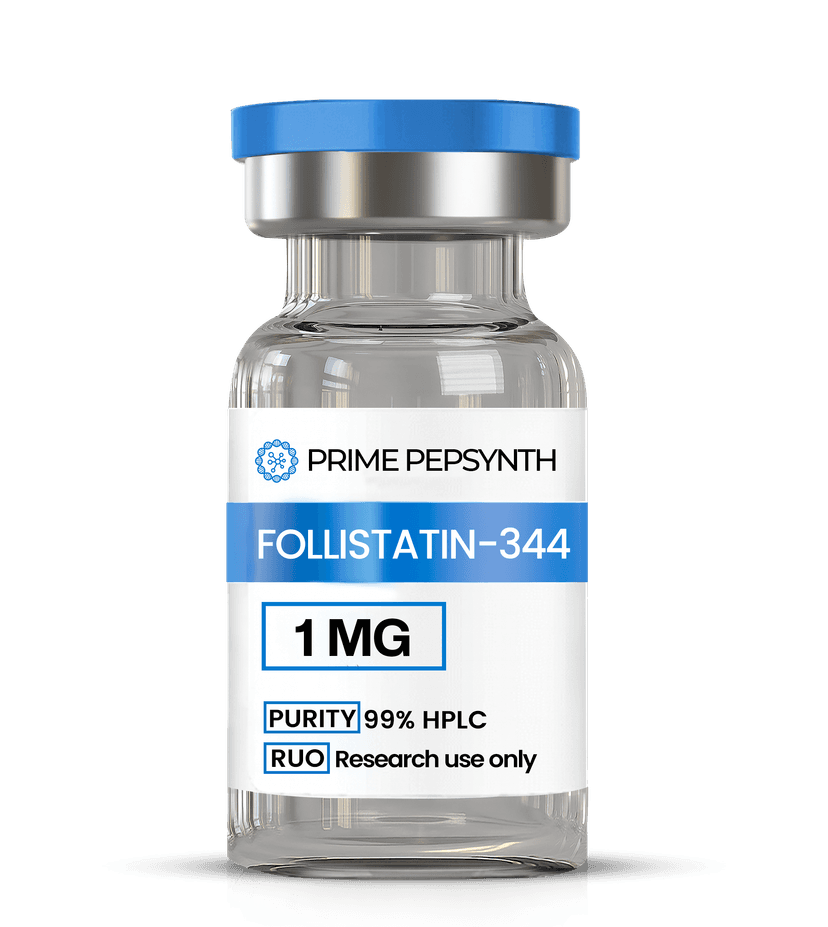
Follistatin-344 is a full-sized synthetic analogue of naturally occurring Follistatin. It neutralizes the effects of myostatin, activin, and follicle stimulating hormone (FSH). In animal studies, these actions lead to increased muscle mass (both hypertrophy and hyperplasia), reduced scar formation, and inhibited certain inflammatory responses. Follistatin-344 can be altered by the body to produce other variants of Follistatin.
What Is Follistatin 344?
Follistatin (FST) 344 is a synthetic version of the naturally occurring
human follistatin protein. Follistatin is found in nearly all tissues of
higher animals and comes in two separate isoforms as a result of
alternative gene splicing. Its primary biological function is
neutralization of proteins in the TGF-beta superfamily. It has
particularly potent neutralizing effects on activin, myostatin, and
follicle-stimulating hormone.
Follistatin 344 Structure
Sequence: MVRARHQPGG LCLLLLLLCQ FMEDRSAQAG
NCWLRQAKNG RCQVLYKTEL SKEECCSTGR LSTSWTEEDV
NDNTLFKWMI FNGGAPNCIP CKETCENVDC GPGKKCRMNK
KNKPRCVCAP DCSNITWKGP VCGLDGKTYR NECALLKARC
KEQPELEVQY QGRCKKTCRD VFCPGSSTCV VDQTNNAYCV
TCNRICPEPA SSEQYLCGND GVTYSSACHL RKATCLLGRS
IGLAYEGKCI KAKSCEDIQC TGGKKCLWDF KVGRGRCSLC
DELCPDSKSD EPVCASDNAT YASECAMKEAACSSGVLLEV
KHSGSCNSIS EDTEEEEEDE DQDYSFPISS ILEW
Molecular Weight: 3780 g/mol
PubChem CID: 178101631
Synonyms: Activin-Binding Protein, FSH-Suppressing Protein, FST
Follistatin 344 Effects
Follistatin Research and Muscle Growth
Myostatin is a protein produced by muscle cells themselves that
inhibits muscle cell growth and differentiation. It is a member of the
TGF-beta protein family and therefore is susceptible to inhibition by
follistatin. Previous research has shown that animals lacking
myostatin have significantly more muscle mass and are stronger
than normal. This led scientists to speculate that administration of
follistatin could improve muscle grov,'th and help to treat a number of
medical conditions, like muscular dystrophy, that impact muscle
growth and strength
In mouse models, follistatin has been shown to increase lean
muscle mass without the need for special dietary or exercise
requirements. After just eight weeks of follistatin injections, mice in
the treatment group had 10% more muscle mass than mice in the
control group['l. This, again, is a result obtained without exercising
the mice or subjecting them to special diets, indicating that gains
could be even more substantial with appropriate training-
Research in everything from mice to monkeys has shown increased
muscle size and strength when follistatin therapy is initiated. There
is hope that the protein can be used to treat muscle disorders, such
as inclusion body myositis, that have so far proved relatively
resistant to pharmacologic interventiona. Research in mouse
models of Duchenne muscle dystrophy (DMD), for instance, show
that follistatin treatment leads to hypertrophy of skeletal muscle
while also reducing inflammation and fibrosis. The benefits are
dose-dependent and lead to clinically relevant changes in strength
in the setting of DMD[31. These are significant findings that could
help doctors to reduce or eliminate the weakness associated with
certain muscle disorders, thereby restoring quality of life and
reducing morbidity in these conditions.
One interesting aspect of research into the effects of follistatin on
musde growth has found that gene administration of follistatin at
any age can lead to long-term benefits on muscle hypertrophy•. In
mouse models, one-time administration of follistatin via gene
therapy has led to more than two years of enhanced mass and
strength in both normal and dystrophic animals. These benefits
were observed regardless of the age of the animal at the time of
gene therapyla]_
Research indicates that follistatin boosts muscle grow'th by
stimulating the insulin/lGF-1 pathway. Interestingly, the protein only
requires that one of these signaling molecules be present for full
anabolic effect Follistatin actually causes a decrease in muscle
expression of IGE-I, something that was initially counter-intuitive to
scientists until they understood that its effects can also be mediated
via insulin itself(S). Research indicates that follistatin influences the
pancreas to produce more insulin, suggesting that the protein is
intimately associated with insulin signaling.
Follistatin May Improve Survival in Breast Cancer
The presence of follistatin in breast tumors was examined in a
clinical study using reverse transcription polymerase chain reaction
(RT-PCR) as well as immune-histochemistry techniques. It was
found that follistatin is under-expressed in breast cancer for the
most part, but is over-expressed in a small proportion of cases. In
the cases where follistatin is over-expressed, tumors grow faster but
are less invasive[€l. The presence of follistatin correlates strongly
with survival and reduce breast cancer metastasis.
The ability of follistatin to suppress metastasis was confirmed using
a mouse model of HER2-positive breast cancer. It was found that
follistatin blocks activin-induced migration of breast epithelial cells,
but the protein is lacking in the average breast tumor. Restoring
follistatin was found to completely block the formation of lung
metastases even though it had no impact on tumor grow'th[7J.
Follistatin plays a role in benign proliferative disorders of the breast
as well. Conditions like fibroadenoma, florid hyperplasia without
atypia, ductal carcinoma in situ, and more are all characterized by
increased levels of FST Once again, the trend is toward follistatin
boosting local grow'th while reducing the probability of distant
metastasis[8].
Follistatin in Esophageal Cancer
Research has identified bone morphogenic protein (BMP) as a
causative agent in the transition of normal esophageal tissue to
Barrett's esophagus, a precursor to cancer. It appears that acid
reflux over-activates BMP in the esophagus and that counteracting
this over-activation, such as through follistatin supplementation,
could prevent the development of Barrett's esophagus in the first
place.
BMP misregulation is actually a common theme in a number of
different cancers. For instance, impaired BMP signaling is important
in the progression of colon cancer. More research clearly needs to
be done, particularly in animal models, to better quanti$' how
follistatin can be used in the treatment and prevention of BMP
misregulation.
Follistatin Research and Cancer Treatment
Researchers have found that follistatin active in a number of
different tumors and that its effects are not just limited to breast
cancer and liver carcinoma. With better understanding of how
follistatin works, it is hoped that a number of clinical applications for
the protein can be developed. Currently, follistatin expression has
been associated with improved survival in breast cancer, but
shortened survival in lung, ovarian, and gastric cancers. It is hoped
that understanding these differences in how the protein affects
survival will allow for the development of treatment ac$uvant tailored
to specific types of cancer. Follistatin research may even form the
basis of a cancer preventative or vaccine, slowing rates of
metastasis and improving long-term survival[g].
Follistatin Associated with Cell Proliferation
The research into breast cancer revealed an odd dichotomy in that
follistatin promotes cell proliferation but restricts metastasis. As it
turns out, this dichotomy of follistatin is true in most tissues. In the
liver, in particular, hepatocytes require follistatin expression in order
to proliferate- Rat models show that the inactivation of activin via
follistatin may be necessary for proliferation to take place[10J. This
may explain why follistatin is associated with increased tumor
growth, but decreased tumor invasion and metastasis. There is
likely an energy trade off that takes place during growth in which the
migratory functions of a cell are shut off in order to shunt energy into
grow'th and reproduction.
Follistatin Research and Liver Protection
Follistatin has been shown to protect the liver against the earliest
phases of fibrosis and thus slow progression of liver disease.
Research in rats shows a 32% reduction in fibrosis after four weeks
of follistatin treatment, a positive trait attributed to an 87% reduction
in hepatocyte death in treatment Dysregulation of
follistatin has been linked to the progression of fibrosis to cancer in
the liver[12]
Follistatin Provides Insight into Congenital Blindness
The ability of the optic nerve to fuse in early development is critical
to ability of humans to see. It has been known for some time that
TGF-beta signaling is critical to remodeling of the extracellular
matrix and eventual fusion of the optic nerve- Research suggests
that high levels of TGF-beta proteins, particularly bone morphogenic
protein (BMP), suppress optic fusion and can lead to blindness.
Inhibition of these proteins can override their effect and lead to
fusion, thereby ensuring the optic nerve is intact and thus vastly
reducing risk of blindness[lJ]. There is basic research into the
benefits of follistatin supplementation during critical development
periods of pregnancy to ensure that optic nerve fusion takes place.
Follistatin Research and Hair Growth
Research in humans indicates that follistatin, particularly when used
in combination with other hair-gro•wth stimulants, can improve hair
grov,'th substantially. Measurements in a small trial of 26 individuals
showed a 20% increase in hair density and a nearly 13% increase in
overall thickness. These results remained for at least one year
following treatment with a single intradermal injection of a
follistatin/Wnt- complex[u]
Follistatin Research and Insulin Deficiency and Diabetes
Research in mice indicates that over-expression of follistatin can
actually increase the mass of beta-islet cells, the cells responsible
for producing insulin. This leads to an improvement in insulin levels,
decreased fasting glucose levels, and a decrease in the symptoms
of diabetes. Most importantly, mice treated with follistatin doubled
their lifespans as the complications of diabetes were virtually
eliminated[151. There is hope that follistatin may shed some light on
how to improve both type I and type 2 diabetes by boosting the
function of whatever functional islet cells are left in the pancreas.
This approach is similar to using exogenous insulin to treat
diabetes, but benefits from being subject to all of the normal
physiologic controls that regulate normal insulin release. With
improved physiologic dosing of insulin comes improved outcomes in
diabetes.
The Future of Follistatin Research
Follistatin research touches a number of human conditions from
cancer and muscle dysfunction to hair growth and diabetes. The
field is very active, with new research published frequently and new
insight into the complex physiology of follistatin being gained
regularly. There is a great deal of potential in follistatin research,
including the potential to develop therapies for a variety of diseases
as well as an ability to probe deeper into human physiology.
Follistatin 344 exhibits moderate side effects, Iow oral and excellent
subcutaneous bioavailability in mice. Per kg dosage in mice does
not scale to humans. Follistatin 344 for sale at Peptide Sciences is
limited to educational and scientific research only, not for human
consumption. Only buy Follistatin 344 if you are a licensed
researcher.
Article Author
The above literature was researched, edited and organized by Dr
Logan, M.D- Dr Logan holds a doctorate degree from Case
Western Reserve University School of Medicine and a B.S. in
molecular biology