
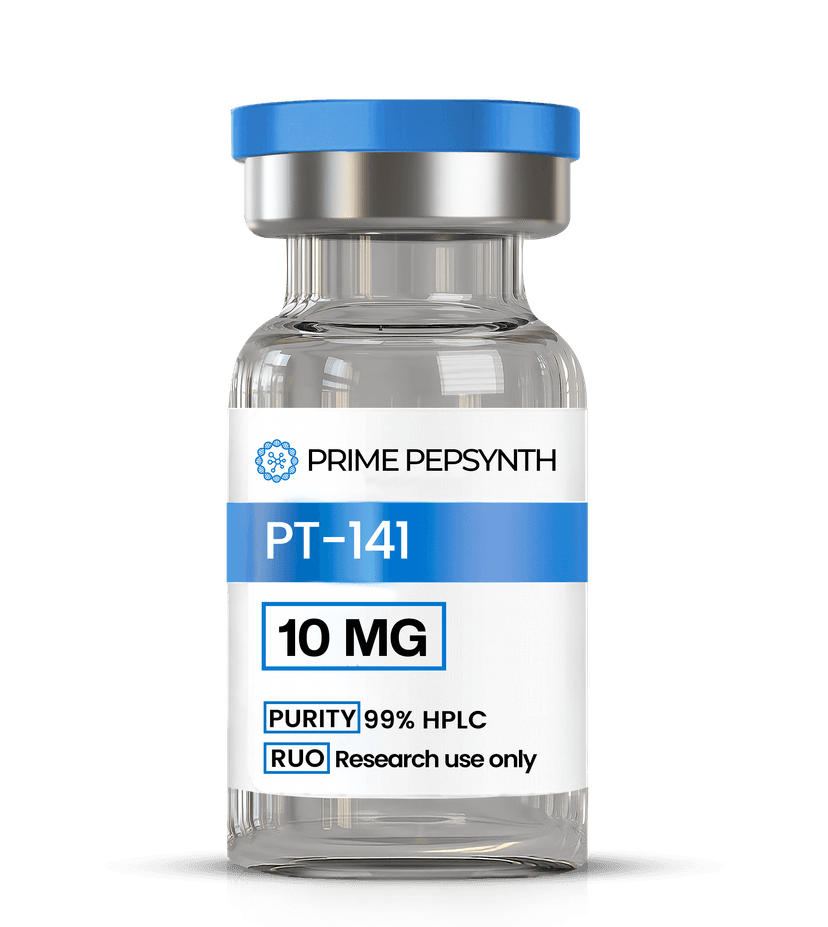
PT-141, also called Bremelanotide (generic clinical name), is a heavily modified synthetic derivative of alpha-melanocyte-stimulating hormone. It has been tested in clinical trials as a treatment for both male/female hypoactive sexual desire disorder and acute hemorrhage. PT-141 is an agonist for the melanocortin-4 and melanocortin-1 receptors. Research shows that it promotes sexual arousal and stimulates the immune system.
What Is PT-141 ?
PT-141 , also called bremelanotide, is sometimes referred to as the female Viagra because
the peptide was previously investigated in phase 11b human clinical trials for use in treating
female hypoactive sexual desire disorder (HSDD). PT-141 is a melanocortin that binds
primarily to melanocortin 4 receptor (MC-4R) and MC-IR. In 2009, PT-141 was also
investigated as a treatment for acute hemorrhage. PT-141 is a derivative of another
synthetic melanocortin, melanotan 2 (MT-2).
PT-141 Molecular Structure
Sequence: )
Molecular Formula: C H N O
Molecular Weight: 1025.182 g/mol
PubChem CID: 9941379
CAS Number: 189691-06-3
PT-141 Research
PT-141 and Sexual Arousal
PT-141 is a unique peptide in that it stimulates the MC-4R, which is known to produce
sexual arousal in the central nervous system and influence sexual behavior[l], [21. Studies
in mice have shown that agonist binding to MC-4R causes sexual arousal and increased
copulation in both males and females[3], [41. Because PT-141 works via a different
mechanism than drugs like Viagra, it is possible to treat sexual arousal disorders in both
men and women that stem from causes other than reduced blood low to the genitals.
A study of men with erectile dysfunction (ED) who did not respond to sildenafil (Viagra)
found that roughly one third experienced adequate erection for sexual intercourse with PT-
141 (administered via nasal spray). There was also a strong dose-dependent response in
the trial, indicating that PT-141 is indeed effective in certain cases[l. This suggests that PT-
141 could offer insight into correcting ED in settings where Sildenafil has failed and may
offer insight into central causes of hypoactive sexual desire.
Interestingly, PT-141 was pulled from clinical trials before it reached approval for use in
women suffering from HSDD. This is despite signs that the drug increased the number of
satisfying sexual events per month and decreased female sexual distress scores in a
statistically significant manner without any substantial side effects[6]. Many experts Who
treat female sexual dysfunction (FSD) were dismayed to find the peptide was not being
advanced despite positive results. They point to a lack of established endpoints for trials of
FSD and socio-cultural biases against women's sexual health as the primary roadblocks
that are inhibiting approval of What they see as much-needed therapies[7]_ They hope that
greater attention Will be given to the topic and that the FDA will establiSh more concrete
guidelines for evaluating therapies like PT-141 that can offer benefit. These experts also
expressed dismay that the pharmacological treatments were not tested in conjunction with
other established means of treating sexual dysfunction as they believe that the
combination may prove synergistic and that peptides like PT-141 may be useful for
overcoming initial barriers and jump-starting psychological treatment modalities.
In 2017, partly in response to the outcry against the cessation of earlier trials, Phase II
Reconnect trials were launched using subcutaneous injections of PT-141 for FSD. The
newest version of PT-141, called Rekynda, may soon be available for use in the United
States. It would be legal to use PT-141 off-label, at that point, to treat both male and
female sexual dysfunction[a]. These new trials have relied on the kind of modified
endpoints that experts in FSD have touted as beneficial to seeing these kinds of
treatments approved.
PT-141 and Hemorrhage
In 2009, PT-141 was modified slightly and investigated as a potential treatment for
hemorrhagic shock Because PT-141 binds to both MC-IR and MC-4R, it reduces
ischemia and protects tissues against inadequate blood supply in the setting of
hypovolemic (hemorrhagic) shock The drug, when administered intravenously, does not
produce substantial Side effects. It was last in Phase 11b mats. The modified version of PT-
141 is referred to as PL-6983.
PT-141 and Infection
The MC-IR has been found, in a rat model of a specific fungal infection, to possess
important anti-fungal and anti-inflammatory properties[9]_ This is of particular importance
because current anti-fungals are limited in terms of their mechanism of action and all
produce serious and treatment-limiting side effects in certain patients. Having an
alternative to use in the treatment of fungal infections could reduce morbidity and mortality
substantially, especially in patients with immune compromise.
PT-141 and Cancer
The MC-IR receptor is an important stimulus of DNA repair pathways and thus is of
interest in cancer treatment and prevention[tal. Research shows that people with variants
of MC-I R are at increased risk for both basal cell and squamous cell carcinoma[ll]_
Altered PT-141 may be able to correct the problems experienced as a result of these
variants and prevent or treat these cancers.
Research Directions
Right now, PT-141 has received widespread and
intense attention as a treatment for sexual
dysfunction. There is, however, a great deal of
potential research outside of sexual dysfunction
and hemorrhage that PT-141 could be applied to.
For instance, MC-4R is well-known to be defective
or missing in certain cases of obesity and may
account for as much as 6% of all cases of early-
onset obesity. PT-141 offers a unique means of
exploring this particular cause of obesity and
potentially illustrating a pathway for intervention.
MC-IR plays roles in both pain and inflammation
as well as kidney pathology and the spread of
infection. There is a plethora of available research
that PT-141 could help to shed light on.
PT-141 exhibits minimal side effects, low oral and
excellent subcutaneous bioavailability in mice. Per
kg dosage in mice does not scale to humans. PT-
141 for sale at Peptide Sciences is limited to
educational and scientific research only, not for
human consumption. Only buy PT-141 if you are a
licensed researcher.
Article Author
The above literature was researched, edited and
organized by Dr. Logan, M.D. Dr. Logan holds a
doctorate degree from Case Western Reserve
University School of Medicine and a B.S. in
molecular biology.
Scientific Journal
Author
Dr. Sheryl A. Kingsberg is the chief of behavioral
medicine at University Hospitals Case Medical
Center and professor in Reproductive Biology and
Psychiatry at Case Westem Reserve University.
Her areas of clinical specialization include sexual
medicine, female sexual disorders, cognitive
behavioral psychotherapy, menopause, pregnancy
and postpartum mood disorders, psychological
aspects of infertility, and psychological and sexual
aspects of cancer. Dr. Kingsberg's primary
research interests are in treatments for female
sexual disorders and the psychological aspects of
infertility and menopause. She led a randomized,
placebo-controlled dose-finding trial for PT-
141. She has numerous publications in many
national and international journals, sits on the
editorial board of Menopause and has authored
numerous chapters on topics including
perimenopause and sexuality, oocyte donation,
infertility and aging, the treatment of psychogenic
erectile dysfunction and sexuality after cancer. Dr.
Kingsberg received her PhD from the University of
South Florida in Tampa and completed her
fellowship in sexual medicine at University
Hospitals Case Medical Center She is an active
member in a number of national and international
organizations including the American Psychological
Association and the American Society for
Reproductive Medicine. She currently sits on the
Board of Trustees of The North American
Menopause Society, and serves as the current
treasurer of the Society for Assisted Reproductive
Technologies. Dr. Kingsberg s a past president of
The Intemational Society for the Study of Women's
Sexual Health.
Dr. Sheryl A. Kingsberg is being referenced as one
of the leading scientists involved in the research
and development of PT-141. In no way is this
doctor/scientist endorsing or advocating the
purchase, sale, or use of this product for any
reasom There is no affliation or relationship,
implied or otherwise, between Peptide Sciences
and this doctor. The purpose of citing the doctor is
to acknowledge, recognize, and credit the
exhaustive research and development efforts
conducted by the scientists studying this
peptide. Dr. Kingsberg is listed in [12] under the
referenced citations.